Mölkky, explained
Mölkky is a Finnish throwing game played with twelve numbered pins and a wooden stick. First to exactly fifty points wins.
Updated August 13, 2026 · 5 min read
Mölkky is a Finnish throwing game. Twelve wooden pins numbered 1 to 12 stand in a tight bunch about 3.5 metres away, and players take turns throwing a thirteenth piece of wood — the mölkky — underarm to knock them over. Knock over one pin and you score its number. Knock over several and you score how many fell. The first player to reach exactly fifty points wins; go over and you drop back to twenty-five.
That is the whole game, and it takes about a minute to teach. What keeps people playing is the arithmetic underneath it: every throw is a choice between a big number that might overshoot and a safe one that keeps you in range, and the pins spread further apart as the game goes on, so the shot that was easy in round one is not there in round nine.
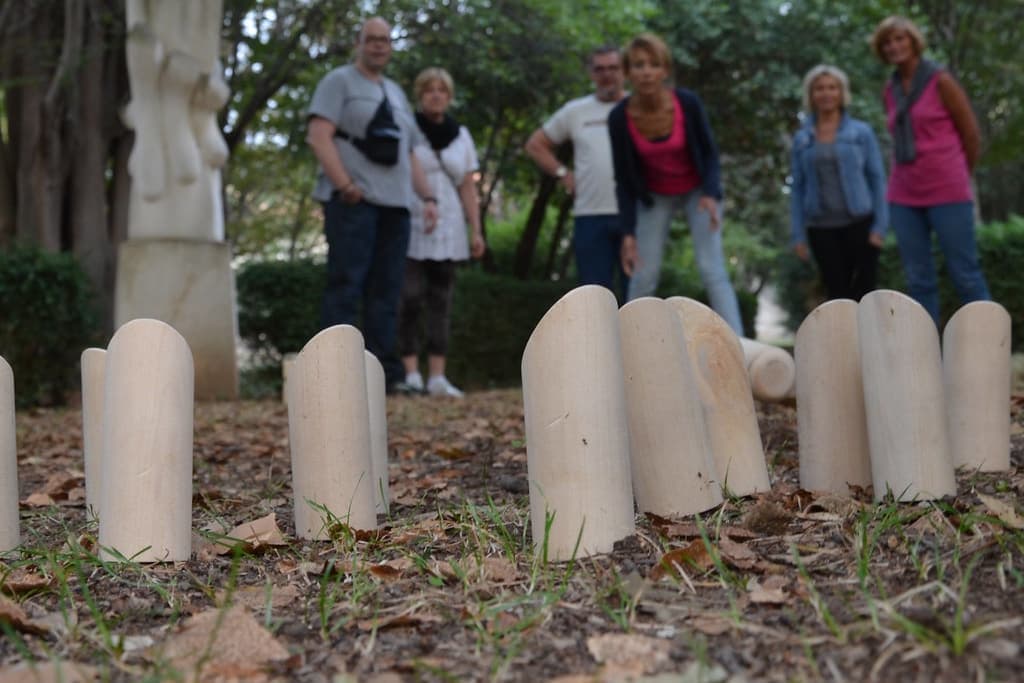
Where Mölkky comes from
Mölkky was designed in 1996 by the Finnish company Lahden Paikka, who based it on kyykkä — a much older Karelian game played on ice with a heavy wooden bat. Kyykkä is demanding and takes a large pitch. Mölkky kept the underarm throw and the wooden pieces, shrank the whole thing down to something you carry in one hand, and replaced brute force with counting.
It spread from Finland across the Nordics and into France, which now has one of the largest playing populations outside Finland and where the game is often sold as jeu de quilles finlandais. There has been a World Championship since 1997, usually in Lahti.
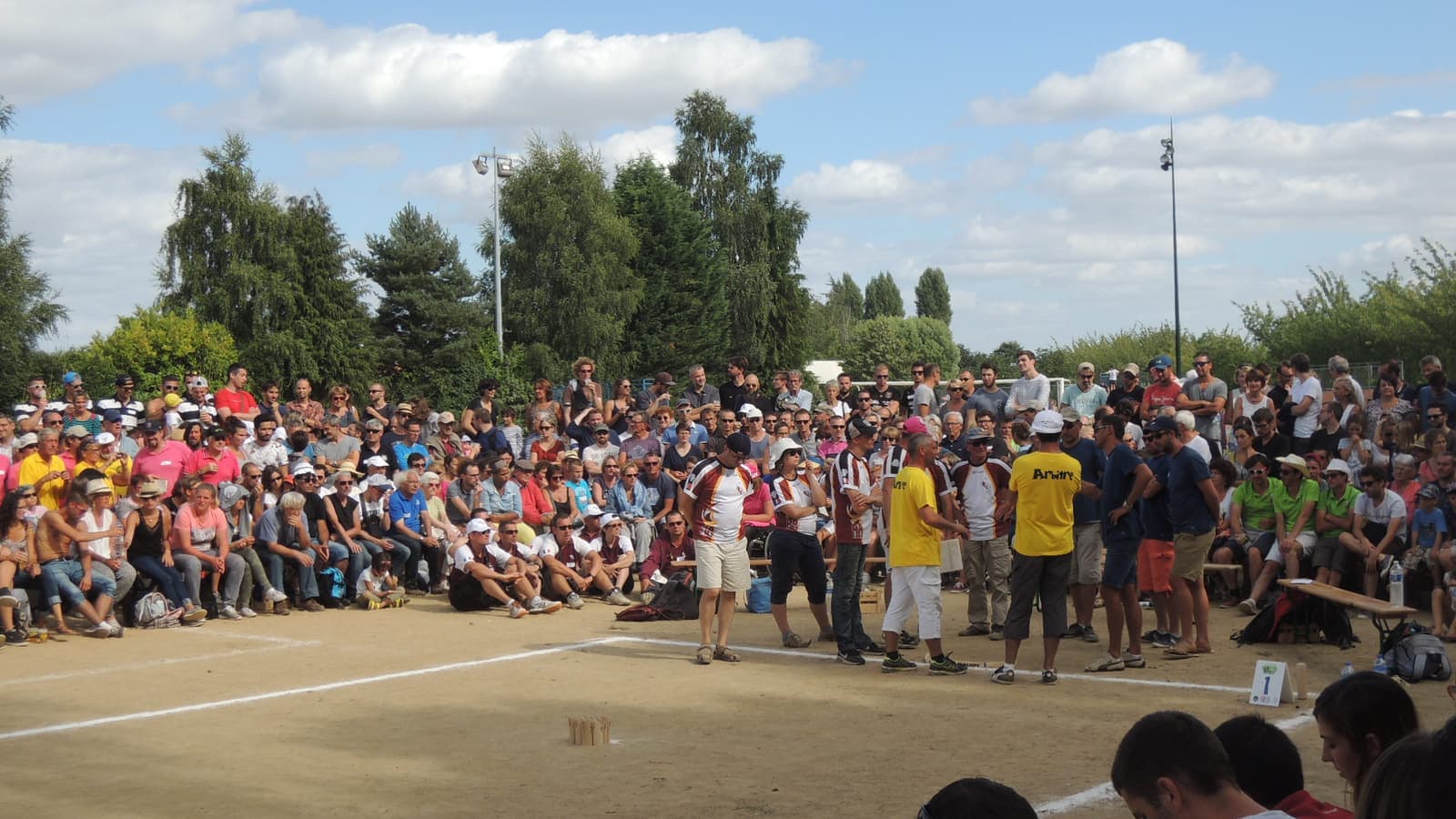
What is in a set
The pins are flat-topped cylinders cut off at an angle, about 55 mm across and 150 mm tall, with the number printed on the slanted face so it can be read from the throwing line. The mölkky is a plain cylinder of the same diameter and roughly 225 mm long — no number, no marking. Everything is birch.
Nothing else is needed. No pitch, no net, no boundary. That portability is most of why the game travels: a set fits in a canvas bag the size of a loaf of bread and can be set up on any reasonably flat ground in ten seconds.
The twelve pins and their numbers covers the layout in detail — which number stands where, and why the arrangement is not random.
How a game actually goes
Players throw in a fixed order. On your turn you stand behind the throwing line and throw the mölkky underarm at the formation.
- One pin down — you score the number printed on that pin. Only the 12 falls, that is twelve points, and it is the single biggest throw in the game.
- Two or more pins down — you score the count, not the numbers. Five pins is five points, whether they are 1–5 or 8–12.
- Nothing down — no score, and a miss is recorded against you.
Then every pin that fell is stood back up exactly where it came to rest. This is the rule that shapes the whole game. The pins begin in a tight bunch where a good throw can take five or six at once, and they end scattered across several metres where hitting one specific number is genuinely hard. Late in a game, "I need exactly 3" can mean threading the mölkky between two pins two metres apart.
Let the app keep score
Exactly fifty, the drop back to twenty-five, three misses and out — the app tracks all of it while you play. No account, and it works with no signal.
Open the scorekeeperWinning, and the trap in the middle
You must land on exactly 50. A throw that would take you past it does not win and does not simply fail — your score drops back to 25 and play continues.
That single rule is what makes Mölkky a game rather than a target exercise. Sitting on 44, the twelve pin is worthless to you and the 6 is everything. A player on 47 wants a three-pin cluster and nothing else. Meanwhile the player on 12 can swing at anything. Reaching exactly fifty goes through the arithmetic properly, including why 25 rather than 0 is the right penalty.
The other way to leave the game is by missing. Three scoreless throws in a row and you are out for the rest of the game. Any scoring throw resets the count. In friendly games this is often softened — three misses and what to do about them covers both the official rule and the version people actually use with children.
Is it any good?
Honestly assessed: it is one of the best garden games there is for a mixed group, and for two specific reasons.
The first is that skill and luck are balanced in an unusual way. A strong thrower will beat a weak one over a long game, but not every game — the exact-50 rule means being good at knocking pins over is not enough, and a player who counts well can beat a player who throws well.
The second is that it does not exclude anyone. Nobody has to run, the throwing action is gentle, a seven-year-old and a seventy-year-old can play the same game without handicaps, and a round takes twenty minutes. Very few games manage all four.
Where it falls down: it needs reasonably flat ground, twelve pins scattered across a lawn are easy to lose in long grass at dusk, and with more than eight players the wait between throws gets tedious. For a big group, split into two games rather than one long one.
Where to go next
If you are about to play for the first time, the rules is the page you want — it is the complete official ruleset, written to be read in five minutes. If you have played and want to get better, start with the twelve pins and learn where the numbers sit; almost all early improvement comes from aiming at a specific pin rather than at the group.
Every page in this guide
Frequently asked questions
Is Mölkky the same as kubb?
No. Both are Nordic lawn games thrown underarm, but Mölkky is Finnish, uses twelve numbered pins and is scored to exactly fifty. Kubb is Swedish, uses unnumbered blocks, and is won by knocking over the king last.
How do you pronounce Mölkky?
Roughly "MURL-kew", with the ö close to the vowel in "her". In Finnish the double k is held slightly longer than a single one.
How many people can play Mölkky?
Two to a dozen or more. It works with any number of individual players and with teams, though a game slows noticeably past about eight throwers.
Do you need a lawn to play Mölkky?
No. Grass, gravel, sand and hard dirt all work. Grass is kindest to the pins; a hard surface makes throws bounce further and the game livelier.
Let the app do the counting
Exactly fifty, the drop back to twenty-five, three misses and out. Add names and start scoring in ten seconds — no account, no signal needed.