The rules
The complete official Mölkky rules — scoring, the exact-fifty target, three misses, order of play and the common house variants.
Updated August 13, 2026 · 5 min read
Mölkky is played with twelve numbered pins, thrown at from 3.5 metres with a wooden stick. One pin down scores its number; two or more scores the count of pins that fell. Fallen pins are stood back up where they land. The first player to reach exactly fifty wins — going over drops you back to twenty-five — and three scoreless throws in a row puts you out.
Everything below is the official ruleset as published by the Mölkky federations, in the order you need it. Where a rule is commonly bent, that is said plainly rather than left out.
Setting up
Stand the twelve pins in a tight block, four rows deep, touching each other:
The front row (1 and 2) is nearest the throwers and parallel to the throwing line. Measure 3.5 metres from the front pin to the line. On uneven ground, find the flattest patch you can — a formation on a slope collapses under its own weight before anyone has thrown.
The twelve pins has the full layout and the reasoning behind the number placement.
Order of play
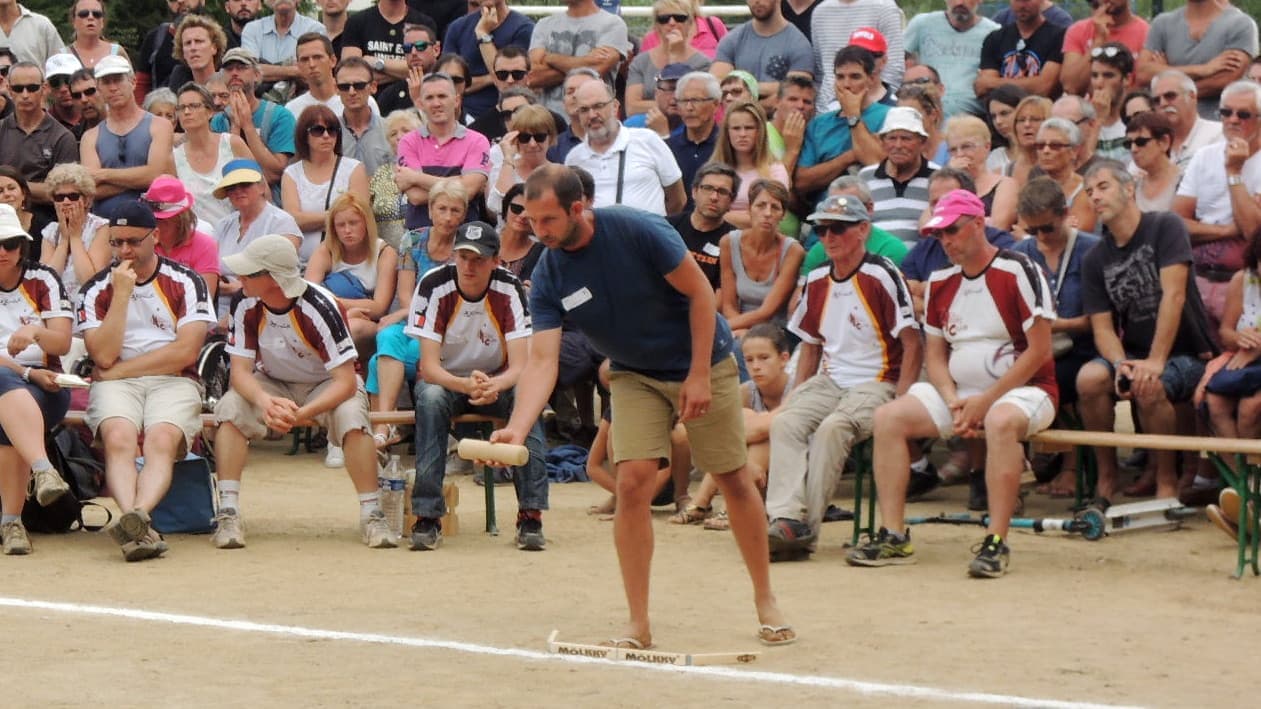
Players throw one after another in a fixed order, which does not change during the game. The official rules do not prescribe how the order is chosen; the usual method is a single throw each before the game starts, ordered by result.
Each turn is one throw. You must throw:
- Underarm, with the mölkky swinging below the hand.
- From behind the throwing line, with both feet behind it at the moment of release.
- Without spinning the mölkky end over end deliberately. A natural tumble is fine; a helicopter throw is not.
Overarm throws, sideways throws and stepping over the line all make the throw void — no score, and it counts as a miss.
Scoring
This is the part everyone gets wrong on their first game, so it is worth being exact about it.
One pin falls → you score the number printed on that pin. The 12 alone is twelve points, the biggest single throw available.
Two or more pins fall → you score the number of pins that fell. Not the sum. Knocking over 9, 11 and 12 together scores three.
No pins fall → nothing, and a miss is recorded.
A pin counts as fallen only if it ends up flat on the ground. A pin leaning on another pin, or on the mölkky, is still standing and is set back upright on its own spot.
How Mölkky scoring works goes through this with worked examples, including the cases that cause arguments.
Standing the pins back up
After the throw is scored, every pin that fell is stood back upright exactly where it came to rest. Not back in formation, and not moved to a tidier spot.
This is the rule that makes the game. The block starts tight — a good early throw takes five or six pins — and gradually scatters over several metres, until picking off one specific number is a real shot. A group that quietly re-forms the block after every throw is playing a much duller game.
If a pin ends up on top of another, or leaning against something, stand it as close to where it landed as it can stand on its own.
Reaching exactly fifty
You win by reaching exactly fifty points. A throw that would take you above fifty does not win, and does not simply not count: your score is set back to twenty-five and the game continues.
So a player on 46 needs a 4 and nothing else. A player on 38 has a wide range of safe throws. And a player who has just been knocked back to 25 is often better placed than the one on 49, because they can swing at anything while the leader is fishing for a single specific pin.
Reaching exactly fifty covers the arithmetic properly, including why the penalty is 25 and not zero.
Three misses and you are out
Three consecutive scoreless throws eliminate a player for the rest of the game. Any throw that scores — even one point — resets the count to zero.
A void throw (overarm, over the line) counts as a miss for this purpose.
This is the rule most often softened. With children, or in a game where sitting out for twenty minutes would spoil the afternoon, the usual substitute is that a third miss resets your score to zero and you keep playing. Three misses sets out both versions.
The app knows all of this
Exactly fifty, the drop back to twenty-five, three misses, whose turn it is. Add names and start scoring in ten seconds — no account, works with no signal.
Open the scorekeeperTeams
Teams of two or three players are common and change very little:
- Each team has one score.
- Team members throw in rotation — first thrower of team A, first of team B, second of team A, and so on — and the rotation does not change.
- The three-miss rule applies to the team, not the individual: three scoreless throws in a row by the team as a whole, whoever threw them.
House rules worth knowing
The official ruleset is short and the game absorbs variation well. The three changes most groups make:
Target 25 instead of 50. Halves the game length. The overshoot penalty usually becomes 12 or 15 rather than 25 — the point is that it should be roughly half the target.
Miss reset instead of elimination. A third miss sets your score to zero and you play on. This is the right call with mixed ages.
A shorter throwing line. 3.5 metres is a long way for a small child. Two metres for under-tens, and let them throw from wherever they can reach the formation, is a better game than a strict one nobody enjoys.
What is not worth changing: standing pins back where they land, and the two scoring modes. Those two rules are the game; alter either and you have something flatter.
Every rules page
Every page in this guide
How Mölkky scoring works
One pin down scores its number, two or more scores how many fell. The full Mölkky scoring rule, with worked examples and the edge cases.
Reaching exactly fifty
You must land on exactly fifty to win Mölkky. Go over and your score drops to twenty-five. Here is why, and how to play the endgame.
Three misses and you are out
Three scoreless throws in a row eliminates a player in Mölkky. Here is the official rule, and the reset variant most families actually use.
Frequently asked questions
What are the official rules of Mölkky?
Twelve numbered pins are set in a block 3.5 metres from the throwing line. Knocking over one pin scores its number; knocking over several scores the count. Fallen pins are stood up where they land. First to exactly fifty wins, going over drops you to twenty-five, and three scoreless throws in a row eliminates you.
What happens if you knock over more than one pin in Mölkky?
You score the number of pins that fell, not the sum of their numbers. Knocking over the 11 and the 12 together scores two points, not twenty-three.
Can you play Mölkky in teams?
Yes. Teams alternate throws with one member throwing per turn, in a fixed rotation. The team shares a single score, and the three-miss rule applies to the team rather than to the individual.
Who throws first in Mölkky?
Any fair method — the official rules leave it open. A common one is for each player to throw once at the formation before the game and take the order from the results, highest first.
Let the app do the counting
Exactly fifty, the drop back to twenty-five, three misses and out. Add names and start scoring in ten seconds — no account, no signal needed.